Group Specific Component: Un-fusing the MatMul kernel
In this work, we try to optimize the throughput of multiplication of two matrices in BF16 data format on an AMD XDNA 2 NPU using the AIE-API.
In the following we use the following naming of matrices and dimensions: \(A\times B = C, A\in \mathbb R^{M\times K}, B\in \mathbb R^{K\times N}\)
The AIE-API provides vmac.f that is able to multiply two 8x8 matrices with one instruction and a latency of … cycles. With pipelining, the throughput can be maximized to issuing one vmac.f instruction per cycle. One limiting factor is that the input is expected to be in the BFP16 data format, into which the data has to be converted first.
The required format BFP16 (here, more precisely BFP16ebs8) is aiming to compress floats without losing precision for consecutive numbers in a similar order of magnitude.
It deduplicates information by grouping 8 consecutive floating point values into a representation with a shared exponent. Thus, for 8 values we have one 8-bit exponent, and for each value a sign bit and 7-bit mantissa.
In previous exercises, we converted the data on the fly. Most of the work can be parallelized over the six functional-unit slots provided by the XDNA2 VLIW instruction word.
However, the best kernel found still needs one vmul.f instruction for conversion every two vmac.f instructions at its core.
e.g.:
  vmac.f dm0, dm0, ex2, ex4, r0 ; vlda.conv.fp32.bf16 cmh4, [p0], #64 ; vldb x8, [p1], #64  ; nops                                ; vshuffle x7, x8, x9, r21 ; jnzd r23, r23, p4
  vmac.f dm2, dm2, ex3, ex4, r0 ; nopa                                ; vldb x9, [p1], #64  ; vconv.bfp16ebs8.fp32 ex2, dm4       ; mov m0, r6               ; nopx
  vmul.f dm4, y3, y5, r22       ; vlda.conv.fp32.bf16 cml4, [p0], #64 ; nopb                ; vconv.bfp16ebs8.fp32 ex4, dm4       ; vshuffle x6, x8, x9, r20 ; nopx
  vmac.f dm1, dm1, ex2, ex5, r0 ; vlda.conv.fp32.bf16 cmh4, [p0], #64 ; vldb x8, [p1], #64  ; nops                                ; vshuffle x7, x8, x9, r21 ; nopx
  vmac.f dm3, dm3, ex3, ex5, r0 ; nopa                                ; vldb x9, [p1], #64  ; vconv.bfp16ebs8.fp32 ex3, dm4       ; mov m1, r7               ; nopx
  vmul.f dm4, y3, y5, r22       ; vlda.conv.fp32.bf16 cml4, [p0], #64 ; nopb                ; vconv.bfp16ebs8.fp32 ex5, dm4       ; vshuffle x6, x8, x9, r20 ; nopx
(see baseline_parameterized/tensor_kernel_m1xn1xk1_bf16_bf16_bf16)
Optimally, we aim to schedule one vmac.f per cycle, resulting in the maximum throughput of matrix multiplications, as the vector unit is fully occupied calculating vmac.f multiplications.
In the lecture we found no faster way of converting BF16 to BFP16 on the fly without occupying the vector unit, resulting in a slowdown of factor 1.5 compared to the optimum.
The approach we follow here was to convert all the values beforehand, keeping them in the L1 memory of the compute tile and afterwards using these values for multiplication.
On the higher level this makes sense.
The matrix multiplication is implemented by iteratively computing \(16\times16\) blocks of the result matrix.
4 vmac.f instructions (see code above) compute the results for 8 steps along the \(K\) dimension, which will be accumulated into 4 dm registers.
This block size is capped by the maximum amount of values kept in the dm accumulator registers.
For higher \(K\) values, we cannot keep input values in the registers when we need them for the next 16x16 result block.
Therefore, we must reload them.
For the on-the-fly-conversion implementation, that means converting these values again.
This conversion latency cannot be fully hidden because of the required vmul.f operations.
When the values are already converted, this work would not be needed anymore.
But on the other hand we would need to convert the values beforehand.
The hope is that at some size of \(M\) and \(N\) this overhead will be compensated for by the elimination of duplicate work and lead to a performance improvement.
Expected speedup
As mentioned earlier, the core of both versions (on-the-fly-conversion and preconverted) consists of densely packed vmac.f instructions that are executing the heavy lifting multiplications.
Thus, the number of vmac.f is the same for both implementations and scales with the number of primitive multiplications needed for a matrix multiplication.
In total we will need to compute \(N\cdot M\) output values, accumulated over a depth of \(K\), resulting in \(N\cdot M \cdot K\) primitive multiplications.
Each vmac.f executes \(8\cdot 8 \cdot 8 = 512\) primitive multiplications, so we land at \(\frac {N\cdot M \cdot K}{512}\) vmac.f instructions.
The total expected cycles of the on-the-fly-conversion version are the number of vmacs multiplied by 1.5 (see vmul.f above) plus some constant overhead for the warmup (loading the first values) and cooldown (storing the last results), which cannot be effectively hidden during vmac.fs:
In contrast, at the core of the kernel we aim to reach the optimum of one vmac.f per cycle plus warmup and cooldown.
In addition, we need to convert both input matrices of size \(M\times K\) and \(K\times N\) beforehand.
As we will discuss later, our implementation of the conversion requires 12 cycles for storing an 8x64 matrix block. Assuming that the input matrices are multiples of these blocks, we would need \(\frac{12}{8\cdot64}(MK+KN) = \frac{3}{128}(M+N)K\) cycles plus a constant warmup for loading the first values.
Thus, ignoring constant warmup/cooldown, we expect our implementation to be faster iff:
For the special case of \(N=M\), we expect our implementation to be faster iff \(N^2 > 48N\), i.e. \(N > 48\)
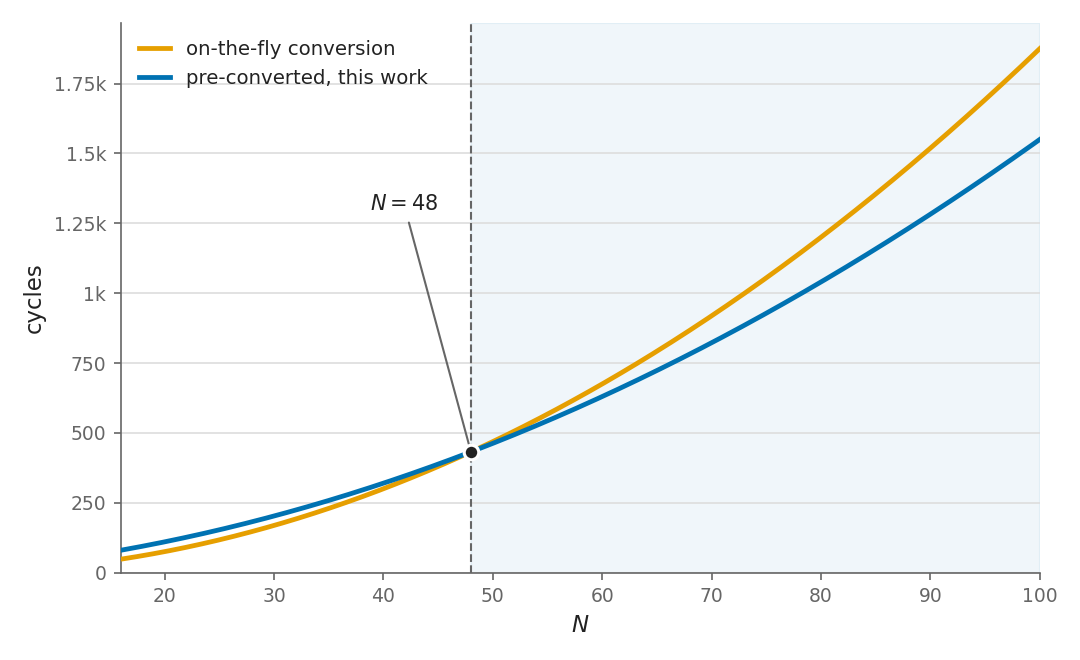
Expected cycles for both implementations over the matrix size \(N\) (with \(M=N\), \(K=64\)). The curves cross at \(N=48\) independently of \(K\); for larger matrices pre-converting wins.
Size limitations in this work
As there is no conceptual speedup expected with our implementation when varying the contraction dimension \(K\) (see above), we keep it fixed at 64.
This work is constrained to matrix multiplications on one compute tile. Because we want to keep the whole converted matrices in the L1 memory, we are limited in the size of the input matrices. Also, we will only implement multiplications with side length \(M=N\) being a power of two.
For \(K=64\) the maximum size of \(M,N\) is derived from the usable size of the L1 cache. Due to double buffering and the need for instruction cache, we can only use 31KiB of the total 64KiB. For loading the 2 input matrices we need 2 bytes per BF16 value with \(64N=64M\) values per matrix; therefore, the maximum \(N\) is
Furthermore, the output matrix also needs to fit into the L1 cache.
The smallest matrix size we implemented is \(M=N=16\). When iterating over \(K\) we can keep accumulation results of the full matrix in 4 of the 5 dm accumulator registers. Therefore, there is no need to reload the data later, and thus the previous on-the-fly-conversion kernel would not execute duplicate conversions and there is no benefit in preconverting the values. Therefore, smaller kernel sizes would not make sense to implement here.
There are 3 remaining sizes of matrix multiplication fulfilling these restrictions, which we implemented: \(K=64, N=M\in\{16, 32, 64\}\)
Implementation
The implementation is split into two kernels: a conversion kernel that rewrites both input matrices from BF16 into the BFP16 block format, and the matmul kernel that consumes the converted data. Both kernels operate entirely on the L1 memory of the compute tile, so no data movement beyond the tile is required between the two phases.
Conversion Kernel
The conversion kernel reads both input tensors in parallel, using the a and the b load engine at the same time.
The hardware can only produce BFP16 from FP32, not directly from BF16, so every input value has to be widened to FP32 before it can be converted. The a load engine does this for free: vlda.conv.fp32.bf16 performs the widening as part of the load instruction. The b load engine has no such conversion variant, so for the second matrix we have to widen explicitly with a vmul.f against a broadcast constant of \(1.0\), which costs one vector slot per loaded block.
Storing the converted data is done with the instruction pair
vst.push.576.conv.bfp16ebs8.fp32 dm0, [p2, sf, r26]
vst.flush.512.conv               [p2, sf, r26]
A single store can only write 64 bytes, but one BFP16ebs8 group of 64 values occupies 72 bytes (8 blocks of 8 mantissas plus their shared exponent byte). One group therefore cannot be emitted by a single store instruction. The vst.push instruction resolves this by writing 64 bytes and recording the 8-byte remainder in r26, which it decrements by 8 on every push. vst.flush then reads r26 and writes out the accumulated remainder. Since a flush can also write a maximum of 64 bytes, one flush is needed after at most eight pushes.
Both instructions are fixed to the registers p2, sf and r26. The pointer, the shift/format register and the remainder counter cannot be substituted by other registers. p2 is a live store cursor that both the pushes and the flush advance on their own, so the base address of a group has to be captured with movs right after the flush and restored with mov before the next group.
For the different sizes we have 3 implementations each:
matmul_not_optimized.s as the first proof of concept implementation with minimal interleaving of operations. It converts the two input matrices one after the other and issues a push only every second cycle, which amounts to 16 cycles per stored 8x64 matrix block.
matmul.s, the fastest implementation we were able to make work during this project. It interleaves the conversion of both input matrices and uses the vector registers as buffers, so that a conversion can be issued in almost every cycle. Since the widening of the b matrix occupies the vector slot, the two matrices are processed in alternating groups of four pushes, each terminated by a flush and a bundle that restores the group base pointer. This brings the cost down to 12 cycles per stored 8x64 matrix block.
and matmul_optimized.s which contains ideas and attempts to further optimize the kernels but that had problems we discuss in the following.
A further optimized Kernel conversion is working. It holds more values in registers, so that a full group of eight pushes can be issued back to back before a flush is needed. One flush and one pointer bundle then amortize over eight pushes instead of four, which reduces the cost to 10 cycles per stored 8x64 matrix block.
Lines 63-118 of matmul_optimized.s contain a further, unsuccessful optimization attempt. There, the bundle that only restores the group base pointer after each flush is removed and the mov p2, p3 is folded into the flush bundle itself, which would save one more cycle per group. The resulting kernel produces wrong data, and we could not determine why: neither the pointer arithmetic nor the fact that the pointer move shares its bundle with the flush explains the failure, since both could be excluded individually in separate experiments.
conv:
nopv                   ; vlda.conv.fp32.bf16 cml0, [p0], #64 ; nopb               ; movs p3, p1                                         ; mov p2, p0      ; nopx
nopv                   ; vlda.conv.fp32.bf16 cmh0, [p0], #64 ; nopb               ; movs p4, p2                                         ; mov m3, #576  ; nopx
nopv                   ; vlda.conv.fp32.bf16 cml0, [p0], #64 ; nopb               ; nops                                                ; mov crrnd, #12  ; nopx
nopv                   ; vlda.conv.fp32.bf16 cmh0, [p0], #64 ; nopb               ; nops                                                ; movxm r3, #16256
nopv                   ; vlda.conv.fp32.bf16 cml0, [p0], #64 ; vldb x0, [p1], #64 ; nops                                                ; vbcst.16 x10, r3 ; nopx
nopv                   ; vlda.conv.fp32.bf16 cmh0, [p0], #64 ; vldb x1, [p1], #64 ; nops                                                ; vbcst.16 x11, r3 ; nopx
nopv                   ; vlda.conv.fp32.bf16 cml0, [p0], #64 ; vldb x2, [p1], #64 ; nops                                                ; mov r4, #60     ; nopx
nopv                   ; vlda.conv.fp32.bf16 cmh0, [p0], #64 ; vldb x3, [p1], #64 ; nops                                                ; mov r26, #0     ; nopx
nopv                   ; vlda.conv.fp32.bf16 cml0, [p0], #64 ; vldb x4, [p1], #64 ; vst.push.576.conv.bfp16ebs8.fp32 dm0, [p2, sf, r26] ; nopm       ; nopx
nopv                   ; vlda.conv.fp32.bf16 cmh0, [p0], #64 ; vldb x5, [p1], #64 ; nops                                                ; nopm       ; nopx
nopv                   ; vlda.conv.fp32.bf16 cml0, [p0], #64 ; vldb x6, [p1], #64 ; vst.push.576.conv.bfp16ebs8.fp32 dm0, [p2, sf, r26] ; nopm       ; nopx
nopv                   ; vlda.conv.fp32.bf16 cmh0, [p0], #64 ; vldb x7, [p1], #64 ; nops                                                ; nopm       ; nopx
nopv                   ; vlda.conv.fp32.bf16 cml0, [p0], #64 ; vldb x8, [p1], #64 ; vst.push.576.conv.bfp16ebs8.fp32 dm0, [p2, sf, r26] ; nopm       ; nopx
nopv                   ; vlda.conv.fp32.bf16 cmh0, [p0], #64 ; vldb x9, [p1], #64 ; nops                                                ; nopm       ; nopx
nopv                   ; vlda.conv.fp32.bf16 cml0, [p0], #64 ; vldb x0, [p1], #64 ; vst.push.576.conv.bfp16ebs8.fp32 dm0, [p2, sf, r26] ; nopm       ; nopx // r26 max -64 danach kaputt
nopv                   ; vlda.conv.fp32.bf16 cmh0, [p0], #64 ; vldb x1, [p1], #64 ; nops                                                ; nopm       ; nopx
nopv                   ; padda [p4], m3                      ; vldb x2, [p1], #64 ; vst.push.576.conv.bfp16ebs8.fp32 dm0, [p2, sf, r26] ; nopm       ; nopx
nopv                   ; nopa                                ; vldb x3, [p1], #64 ; nops                                                ; nopm       ; nopx
nopv                   ; nopa                                ; vldb x4, [p1], #64 ; vst.push.576.conv.bfp16ebs8.fp32 dm0, [p2, sf, r26] ; nopm       ; nopx
vmul.f dm4, y0, y5, r4 ; nopa                                ; vldb x5, [p1], #64 ; nops                                                ; nopm       ; nopx
vmul.f dm4, y1, y5, r4 ; vlda.conv.fp32.bf16 cml0, [p0], #64 ; nopb               ; vst.push.576.conv.bfp16ebs8.fp32 dm0, [p2, sf, r26] ; nopm       ; nopx
vmul.f dm4, y2, y5, r4 ; vlda.conv.fp32.bf16 cmh0, [p0], #64 ; nopb               ; nops                                                ; nopm       ; nopx
vmul.f dm4, y3, y5, r4 ; vlda.conv.fp32.bf16 cml1, [p0], #64 ; nopb               ; vst.push.576.conv.bfp16ebs8.fp32 dm0, [p2, sf, r26] ; nopm       ; nopx
vmul.f dm4, y4, y5, r4 ; vlda.conv.fp32.bf16 cmh1, [p0], #64 ; nopb               ; vst.flush.512.conv [p2, sf, r26]                    ; nopm       ; nopx
vmul.f dm4, y0, y5, r4 ; vlda.conv.fp32.bf16 cml2, [p0], #64 ; vldb x0, [p1], #64 ; nops                                                ; mov p2, p3 ; nopx
vmul.f dm4, y1, y5, r4 ; vlda.conv.fp32.bf16 cmh2, [p0], #64 ; vldb x1, [p1], #64 ; vst.push.576.conv.bfp16ebs8.fp32 dm4, [p2, sf, r26] ; nopm       ; nopx
vmul.f dm4, y2, y5, r4 ; vlda.conv.fp32.bf16 cml3, [p0], #64 ; vldb x2, [p1], #64 ; vst.push.576.conv.bfp16ebs8.fp32 dm4, [p2, sf, r26] ; nopm       ; nopx
nopv                   ; vlda.conv.fp32.bf16 cmh3, [p0], #64 ; vldb x3, [p1], #64 ; vst.push.576.conv.bfp16ebs8.fp32 dm4, [p2, sf, r26] ; nopm       ; nopx
nopv                   ; vlda.conv.fp32.bf16 cml4, [p0], #64 ; vldb x4, [p1], #64 ; vst.push.576.conv.bfp16ebs8.fp32 dm4, [p2, sf, r26] ; nopm       ; nopx
nopv                   ; vlda.conv.fp32.bf16 cmh4, [p0], #64 ; vldb x5, [p1], #64 ; vst.push.576.conv.bfp16ebs8.fp32 dm4, [p2, sf, r26] ; nopm       ; nopx
nopv                   ; vlda.conv.fp32.bf16 cml0, [p0], #64 ; vldb x6, [p1], #64 ; vst.push.576.conv.bfp16ebs8.fp32 dm4, [p2, sf, r26] ; nopm       ; nopx
nopv                   ; vlda.conv.fp32.bf16 cmh0, [p0], #64 ; vldb x7, [p1], #64 ; vst.push.576.conv.bfp16ebs8.fp32 dm4, [p2, sf, r26] ; nopm       ; nopx
nopv                   ; vlda.conv.fp32.bf16 cml1, [p0], #64 ; vldb x8, [p1], #64 ; vst.push.576.conv.bfp16ebs8.fp32 dm4, [p2, sf, r26] ; nopm       ; nopx
nopv                   ; vlda.conv.fp32.bf16 cmh1, [p0], #64 ; vldb x9, [p1], #64 ; vst.flush.512.conv [p2, sf, r26]                    ; nopm       ; nopx
nopv                   ; vlda.conv.fp32.bf16 cml2, [p0], #64 ; vldb x0, [p1], #64 ; nops                                                ; mov p2, p4 ; nopx
nopv                   ; vlda.conv.fp32.bf16 cmh2, [p0], #64 ; vldb x1, [p1], #64 ; vst.push.576.conv.bfp16ebs8.fp32 dm0, [p2, sf, r26] ; nopm       ; nopx
nopv                   ; padda [p3], m3                      ; vldb x2, [p1], #64 ; vst.push.576.conv.bfp16ebs8.fp32 dm1, [p2, sf, r26] ; nopm       ; nopx
nopv                   ; nopa                                ; vldb x3, [p1], #64 ; vst.push.576.conv.bfp16ebs8.fp32 dm2, [p2, sf, r26] ; nopm       ; nopx
nopv                   ; nopa                                ; vldb x4, [p1], #64 ; vst.push.576.conv.bfp16ebs8.fp32 dm3, [p2, sf, r26] ; nopm       ; nopx
vmul.f dm4, y0, y5, r4 ; nopa                                ; vldb x5, [p1], #64 ; vst.push.576.conv.bfp16ebs8.fp32 dm4, [p2, sf, r26] ; nopm       ; nopx
vmul.f dm4, y1, y5, r4 ; nopa                                ; nopb               ; vst.push.576.conv.bfp16ebs8.fp32 dm0, [p2, sf, r26] ; nopm       ; nopx
vmul.f dm4, y2, y5, r4 ; nopa                                ; nopb               ; vst.push.576.conv.bfp16ebs8.fp32 dm1, [p2, sf, r26] ; nopm       ; nopx
vmul.f dm4, y3, y5, r4 ; nopa                                ; nopb               ; vst.push.576.conv.bfp16ebs8.fp32 dm2, [p2, sf, r26] ; nopm       ; nopx
vmul.f dm4, y4, y5, r4 ; nopa                                ; nopb               ; vst.flush.512.conv [p2, sf, r26]                    ; nopm       ; nopx
vmul.f dm4, y0, y5, r4 ; nopa                                ; nopb               ; nops                                                ; mov p2, p3 ; nopx
vmul.f dm4, y1, y5, r4 ; nopa                                ; nopb               ; vst.push.576.conv.bfp16ebs8.fp32 dm4, [p2, sf, r26] ; nopm       ; nopx
vmul.f dm4, y2, y5, r4 ; nopa                                ; nopb               ; vst.push.576.conv.bfp16ebs8.fp32 dm4, [p2, sf, r26] ; nopm       ; nopx
nopv                   ; nopa                                ; nopb               ; vst.push.576.conv.bfp16ebs8.fp32 dm4, [p2, sf, r26] ; nopm       ; nopx
nopv                   ; nopa                                ; nopb               ; vst.push.576.conv.bfp16ebs8.fp32 dm4, [p2, sf, r26] ; nopm       ; ret lr
nopv                   ; nopa                                ; nopb               ; vst.push.576.conv.bfp16ebs8.fp32 dm4, [p2, sf, r26] ; nopm       ; nopx
nopv                   ; nopa                                ; nopb               ; vst.push.576.conv.bfp16ebs8.fp32 dm4, [p2, sf, r26] ; nopm       ; nopx
nopv                   ; nopa                                ; nopb               ; vst.push.576.conv.bfp16ebs8.fp32 dm4, [p2, sf, r26] ; nopm       ; nopx
nopv                   ; nopa                                ; nopb               ; vst.push.576.conv.bfp16ebs8.fp32 dm4, [p2, sf, r26] ; nopm       ; nopx
nopv                   ; nopa                                ; nopb               ; vst.flush.512.conv [p2, sf, r26]                    ; nopm       ; nopx
Matmul Kernel
The matmul kernel reads the converted matrices back with both load engines in parallel. The load side mirrors the store side of the conversion kernel: vlda.fill.512 and vldb.fill.512 prefetch a 64-byte chunk, and vlda.pop.576 and vldb.pop.576 then hand out the 72-byte BFP16 groups, with r24 and r25 tracking the remainder in the same way r26 does for the stores. A pop instructions needs 8 cycles.
For the output tile size of 16x16 kernel issues one vmac.f per cycle, which is the maximum throughput. The vmac.f computation results are converted back to BF16 and written out with vst.conv.bf16.fp32.
vlda.conv.fp32.bf16 cml0, [p2], #64; mov p3, p2
vlda.conv.fp32.bf16 cmh0, [p2], #64
vlda.conv.fp32.bf16 cml1, [p2], #64
vlda.conv.fp32.bf16 cmh1, [p2], #64
nopv                          ; vlda.fill.512 [p0, lf0, r24]        ; vldb.fill.512 [p1, lf1, r25]     ; nops                               ; mov r0, #780 ; movx r25, #0
nopv                          ; vlda.pop.576 ex0 ,[p0, lf0, r24]    ; vldb.pop.576 ex1 ,[p1, lf1, r25] ; nops                               ; mov crrnd, #12 ; movx r24, #0
nopv                          ; vlda.pop.576 ex2 ,[p0, lf0, r24]    ; vldb.pop.576 ex3 ,[p1, lf1, r25] ; nops                               ; nopm           ; nopx
nopv                          ; vlda.conv.fp32.bf16 cml2, [p2], #64 ;nopb                              ; nops                               ; nopm           ; nopx
nopv                          ; vlda.conv.fp32.bf16 cmh2, [p2], #64 ;nopb                              ; nops                               ; nopm           ; nopx
nopv                          ; vlda.pop.576 ex0 ,[p0, lf0, r24]    ;vldb.pop.576 ex1, [p1, lf1, r25]  ; nops                               ; nopm           ; nopx
nopv                          ; vlda.pop.576 ex2 ,[p0, lf0, r24]    ;vldb.pop.576 ex3, [p1, lf1, r25]  ; nops                               ; nopm           ; nopx
nopv                          ; vlda.conv.fp32.bf16 cml3, [p2], #64 ;nopb                              ; nops                               ; nopm           ; nopx
nopv                          ; vlda.conv.fp32.bf16 cmh3, [p2], #64 ;nopb                              ; nops                               ; nopm           ; nopx
vmac.f dm0, dm0, ex0, ex1, r0 ; vlda.pop.576 ex0, [p0, lf0, r24]    ; vldb.pop.576 ex1, [p1, lf1, r25] ; nops                               ; nopm           ; nopx
vmac.f dm1, dm1, ex0, ex3, r0 ; vlda.pop.576 ex2, [p0, lf0, r24]    ; vldb.pop.576 ex3, [p1, lf1, r25] ; nops                               ; nopm           ; nopx
vmac.f dm2, dm2, ex2, ex1, r0 ; nopa                                ; nopb                             ; nops                               ; nopm           ; nopx
vmac.f dm3, dm3, ex2, ex3, r0 ; nopa                                ; nopb                             ; nops                               ; nopm           ; nopx
vmac.f dm0, dm0, ex0, ex1, r0 ; vlda.pop.576 ex0, [p0, lf0, r24]    ; vldb.pop.576 ex1, [p1, lf1, r25] ; nops                               ; nopm           ; nopx
vmac.f dm1, dm1, ex0, ex3, r0 ; vlda.pop.576 ex2, [p0, lf0, r24]    ; vldb.pop.576 ex3, [p1, lf1, r25] ; nops                               ; nopm           ; nopx
vmac.f dm2, dm2, ex2, ex1, r0 ; nopa                                ; nopb                             ; nops                               ; nopm           ; nopx
vmac.f dm3, dm3, ex2, ex3, r0 ; vlda.fill.512 [p0, lf0, r24]        ; vldb.fill.512 [p1, lf1, r25]     ; nops                               ; nopm           ; nopx
vmac.f dm0, dm0, ex0, ex1, r0 ; vlda.pop.576 ex0, [p0, lf0, r24]    ; vldb.pop.576 ex1, [p1, lf1, r25] ; nops                               ; nopm           ; nopx
vmac.f dm1, dm1, ex0, ex3, r0 ; vlda.pop.576 ex2, [p0, lf0, r24]    ; vldb.pop.576 ex3, [p1, lf1, r25] ; nops                               ; nopm           ; nopx
vmac.f dm2, dm2, ex2, ex1, r0 ; nopa                                ; nopb                             ; nops                               ; nopm           ; nopx
vmac.f dm3, dm3, ex2, ex3, r0 ; nopa                                ; nopb                             ; nops                               ; nopm           ; nopx
vmac.f dm0, dm0, ex0, ex1, r0 ; vlda.pop.576 ex0, [p0, lf0, r24]    ; vldb.pop.576 ex1, [p1, lf1, r25] ; nops                               ; nopm           ; nopx
vmac.f dm1, dm1, ex0, ex3, r0 ; vlda.pop.576 ex2, [p0, lf0, r24]    ; vldb.pop.576 ex3, [p1, lf1, r25] ; nops                               ; nopm           ; nopx
vmac.f dm2, dm2, ex2, ex1, r0 ; nopa                                ; nopb                             ; nops                               ; nopm           ; nopx
vmac.f dm3, dm3, ex2, ex3, r0 ; nopa                                ; nopb                             ; nops                               ; nopm           ; nopx
vmac.f dm0, dm0, ex0, ex1, r0 ; vlda.pop.576 ex0, [p0, lf0, r24]    ; vldb.pop.576 ex1, [p1, lf1, r25] ; nops                               ; nopm           ; nopx
vmac.f dm1, dm1, ex0, ex3, r0 ; vlda.pop.576 ex2, [p0, lf0, r24]    ; vldb.pop.576 ex3, [p1, lf1, r25] ; nops                               ; nopm           ; nopx
vmac.f dm2, dm2, ex2, ex1, r0 ; nopa                                ; nopb                             ; nops                               ; nopm           ; nopx
vmac.f dm3, dm3, ex2, ex3, r0 ; nopa                                ; nopb                             ; nops                               ; nopm           ; nopx
vmac.f dm0, dm0, ex0, ex1, r0 ; vlda.pop.576 ex0, [p0, lf0, r24]    ; vldb.pop.576 ex1, [p1, lf1, r25] ; nops                               ; nopm           ; nopx
vmac.f dm1, dm1, ex0, ex3, r0 ; vlda.pop.576 ex2, [p0, lf0, r24]    ; vldb.pop.576 ex3, [p1, lf1, r25] ; nops                               ; nopm           ; nopx
vmac.f dm2, dm2, ex2, ex1, r0 ; nopa                                ; nopb                             ; nops                               ; nopm           ; nopx
vmac.f dm3, dm3, ex2, ex3, r0 ; nopa                                ; nopb                             ; nops                               ; nopm           ; nopx
vmac.f dm0, dm0, ex0, ex1, r0 ; nopa                                ; nopb                             ; nops                               ; nopm           ; nopx
vmac.f dm1, dm1, ex0, ex3, r0 ; nopa                                ; nopb                             ; nops                               ; nopm           ; nopx
vmac.f dm2, dm2, ex2, ex1, r0 ; nopa                                ; nopb                             ; nops                               ; nopm           ; nopx
vmac.f dm3, dm3, ex2, ex3, r0 ; nopa                                ; nopb                             ; nops                               ; nopm           ; nopx
vmac.f dm0, dm0, ex0, ex1, r0 ; nopa                                ; nopb                             ; nops                               ; nopm           ; nopx
vmac.f dm1, dm1, ex0, ex3, r0 ; nopa                                ; nopb                             ; nops                               ; nopm           ; nopx
vmac.f dm2, dm2, ex2, ex1, r0 ; nopa                                ; nopb                             ; nops                               ; nopm           ; nopx
vmac.f dm3, dm3, ex2, ex3, r0 ; nopa                                ; nopb                             ; nops                               ; nopm           ; nopx
nopv                          ; nopa                                ; nopb                             ; nops                               ; nopm           ; nopx
nopv                          ; nopa                                ; nopb                             ; nops                               ; nopm           ; nopx
nopv                          ; nopa                                ; nopb                             ; vst.conv.bf16.fp32 cml0, [p3], #64 ; nopm           ; nopx
nopv                          ; nopa                                ; nopb                             ; vst.conv.bf16.fp32 cmh0, [p3], #64 ; nopm           ; nopx
nopv                          ; nopa                                ; nopb                             ; vst.conv.bf16.fp32 cml1, [p3], #64 ; nopm           ; nopx
nopv                          ; nopa                                ; nopb                             ; vst.conv.bf16.fp32 cmh1, [p3], #64 ; nopm           ; ret lr
nopv                          ; nopa                                ; nopb                             ; vst.conv.bf16.fp32 cml2, [p3], #64 ; nopm           ; nopx
nopv                          ; nopa                                ; nopb                             ; vst.conv.bf16.fp32 cmh2, [p3], #64 ; nopm           ; nopx
nopv                          ; nopa                                ; nopb                             ; vst.conv.bf16.fp32 cml3, [p3], #64 ; nopm           ; nopx
nopv                          ; nopa                                ; nopb                             ; vst.conv.bf16.fp32 cmh3, [p3], #64 ; nopm           ; nopx
For the output tile size 32x32, four 16x16 Output blocks needs to be computed. Since there are only 5 accumulator registers, we need to store the computed output tiles for each block and load the new block. Loads and stores needs two intructions to handle one accumulator regiter, whereas the vmac.f instruction computes and read the whole accumulator register in one instruction. This forces a gap of two nops in the vmac.f instructions, because it has to wait until the registers are stored, before the new output tile can be loaded. Since you have 5 accumultor Register and need only 4 for the 16x16 block, one can register can be preloaded without influencing the current output block.
vmac.f dm1, dm1, ex0, ex3, r0 ; vlda.fill.512 [p0, lf0, r24]        ; vldb.fill.512 [p1, lf1, r25]     ; nops                               ; nopm           ; nopx
vmac.f dm2, dm2, ex2, ex1, r0 ; vlda.pop.576 ex8, [p0, lf0, r24]    ; vldb.pop.576 ex9, [p1, lf1, r25] ; nops                               ; nopm           ; nopx
vmac.f dm3, dm3, ex2, ex3, r0 ; vlda.pop.576 ex10,[p0, lf0, r24]    ; vldb.pop.576 ex11,[p1, lf1, r25] ; nops                               ; nopm           ; nopx
vmac.f dm0, dm0, ex0, ex1, r0 ; vlda.pop.576 ex0, [p0, lf0, r24]    ; vldb.pop.576 ex1, [p1, lf1, r25] ; nops                               ; nopm           ; nopx
vmac.f dm1, dm1, ex0, ex3, r0 ; vlda.pop.576 ex2, [p0, lf0, r24]    ; vldb.pop.576 ex3, [p1, lf1, r25] ; nops                               ; nopm           ; nopx
vmac.f dm2, dm2, ex2, ex1, r0 ; vlda.conv.fp32.bf16 cml4, [p2], #64 ; nopb                             ; nops                               ; nopm           ; nopx
vmac.f dm3, dm3, ex2, ex3, r0 ; vlda.conv.fp32.bf16 cmh4, [p2], #64 ; nopb                             ; nops                               ; nopm           ; nopx
vmac.f dm0, dm0, ex4, ex5, r0 ; vlda.conv.fp32.bf16 cml0, [p2], #64 ; nopb                             ; nops                               ; nopm           ; nopx
vmac.f dm1, dm1, ex4, ex7, r0 ; vlda.conv.fp32.bf16 cmh0, [p2], #64 ; nopb                             ; nops                               ; nopm           ; nopx
vmac.f dm2, dm2, ex6, ex5, r0 ; vlda.conv.fp32.bf16 cml1, [p2], #64 ; nopb                             ; nops                               ; nopm           ; nopx
vmac.f dm3, dm3, ex6, ex7, r0 ; vlda.conv.fp32.bf16 cmh1, [p2], #64 ; nopb                             ; nops                               ; nopm           ; nopx
nopv                          ; vlda.conv.fp32.bf16 cml2, [p2], #64 ; nopb                             ; nops                               ; nopm           ; nopx
nopv                          ; vlda.conv.fp32.bf16 cmh2, [p2], #64 ; nopb                             ; nops                               ; nopm           ; nopx
vmac.f dm4, dm4, ex8, ex9, r0 ; vlda.pop.576 ex0, [p0, lf0, r24]    ; vldb.pop.576 ex1, [p1, lf1, r25] ; vst.conv.bf16.fp32 cml0, [p3], #64 ; nopm           ; nopx
vmac.f dm0, dm0, ex8, ex11, r0; vlda.pop.576 ex2, [p0, lf0, r24]    ; vldb.pop.576 ex3, [p1, lf1, r25] ; vst.conv.bf16.fp32 cmh0, [p3], #64 ; nopm           ; nopx
vmac.f dm1, dm1, ex10, ex9, r0; nopa                                ; nopb                             ; vst.conv.bf16.fp32 cml1, [p3], #64 ; nopm           ; nopx
vmac.f dm2, dm2, ex10, ex11,r0; vlda.pop.576 ex0, [p0, lf0, r24]    ; vldb.pop.576 ex1, [p1, lf1, r25] ; vst.conv.bf16.fp32 cmh1, [p3], #64 ; nopm           ; nopx
vmac.f dm4, dm4, ex0, ex1, r0 ; vlda.pop.576 ex2, [p0, lf0, r24]    ; vldb.pop.576 ex3, [p1, lf1, r25] ; vst.conv.bf16.fp32 cml2, [p3], #64 ; nopm           ; nopx
vmac.f dm0, dm0, ex0, ex3, r0 ; nopa                                ; nopb                             ; vst.conv.bf16.fp32 cmh2, [p3], #64 ; nopm           ; nopx
vmac.f dm1, dm1, ex2, ex1, r0 ; vlda.fill.512 [p0, lf0, r24]        ; vldb.fill.512 [p1, lf1, r25]     ; vst.conv.bf16.fp32 cml3, [p3], #64 ; nopm           ; nopx
vmac.f dm2, dm2, ex2, ex3, r0 ; vlda.pop.576 ex0, [p0, lf0, r24]    ; vldb.pop.576 ex1, [p1, lf1, r25] ; vst.conv.bf16.fp32 cmh3, [p3], #64 ; nopm           ; nopx
Attemps were made to optimise this further in size32/matmul_optimized.s, using just one or zero nops between blocks. But this doesn’t work at the momment and needs further work.
vmac.f dm1, dm1, ex0, ex3, r0 ; vlda.pop.576 ex4, [p0, lf0, r24]    ; vldb.pop.576 ex5, [p1, lf1, r25] ; nops                               ; nopm           ; nopx
vmac.f dm2, dm2, ex2, ex1, r0 ; vlda.pop.576 ex6, [p0, lf0, r24]    ; vldb.pop.576 ex7, [p1, lf1, r25] ; nops                               ; nopm           ; nopx
vmac.f dm3, dm3, ex2, ex3, r0 ; vlda.conv.fp32.bf16 cml4, [p2], #64 ; nopb                             ; nops                               ; mov p6, p0     ; nopx
vmac.f dm0, dm0, ex0, ex1, r0 ; vlda.conv.fp32.bf16 cmh4, [p2], #64 ; nopb                             ; nops                               ; mov p0, p4     ; nopx
vmac.f dm1, dm1, ex0, ex3, r0 ; vlda.fill.512 [p0, lf0, r24]        ; vldb.fill.512 [p1, lf1, r25]     ; nops                               ; nopm           ; nopx
vmac.f dm2, dm2, ex2, ex1, r0 ; vlda.pop.576 ex8, [p0, lf0, r24]    ; vldb.pop.576 ex9, [p1, lf1, r25] ; nops                               ; nopm           ; nopx
vmac.f dm3, dm3, ex2, ex3, r0 ; vlda.pop.576 ex10,[p0, lf0, r24]    ; vldb.pop.576 ex11,[p1, lf1, r25] ; nops                               ; nopm           ; nopx
vmac.f dm0, dm0, ex0, ex1, r0 ; vlda.pop.576 ex0, [p0, lf0, r24]    ; vldb.pop.576 ex1, [p1, lf1, r25] ; nops                               ; nopm           ; nopx
vmac.f dm1, dm1, ex0, ex3, r0 ; vlda.pop.576 ex2, [p0, lf0, r24]    ; vldb.pop.576 ex3, [p1, lf1, r25] ; nops                               ; nopm           ; nopx
vmac.f dm2, dm2, ex2, ex1, r0 ; nopa                                ; nopb                             ; nops                               ; nopm           ; nopx
vmac.f dm3, dm3, ex2, ex3, r0 ; vlda.conv.fp32.bf16 cml2, [p2], #64 ; nopb                             ; nops                               ; nopm           ; nopx
vmac.f dm1, dm0, ex4, ex5, r0 ; vlda.conv.fp32.bf16 cmh2, [p2], #64 ; nopb                             ; nops                               ; nopm           ; nopx
vmac.f dm0, dm1, ex4, ex7, r0 ; vlda.conv.fp32.bf16 cml3, [p2], #64 ; nopb                             ; nops                               ; nopm           ; nopx
vmac.f dm1, dm2, ex6, ex5, r0 ; vlda.conv.fp32.bf16 cmh3, [p2], #64 ; nopb                             ; nops                               ; nopm           ; nopx
nopv                          ; vlda.conv.fp32.bf16 cml4, [p2], #64 ; nopb                             ; nops                               ; nopm           ; nopx
vmac.f dm0, dm3, ex6, ex7, r0 ; vlda.conv.fp32.bf16 cmh4, [p2], #64 ; nopb                             ; nops                               ; nopm           ; nopx
vmac.f dm2, dm4, ex8, ex9, r0 ; nopa                                ; nopb                             ; nops                               ; nopm           ; nopx
vmac.f dm3, dm2, ex8, ex11, r0; vlda.pop.576 ex0, [p0, lf0, r24]    ; vldb.pop.576 ex1, [p1, lf1, r25] ; vst.conv.bf16.fp32 cml1, [p3], #64 ; nopm           ; nopx
vmac.f dm4, dm3, ex10, ex9, r0; vlda.pop.576 ex2, [p0, lf0, r24]    ; vldb.pop.576 ex3, [p1, lf1, r25] ; vst.conv.bf16.fp32 cmh1, [p3], #64 ; nopm           ; nopx
vmac.f dm0, dm4, ex10, ex11,r0; nopa                                ; nopb                             ; vst.conv.bf16.fp32 cml0, [p3], #64 ; nopm           ; nopx
vmac.f dm2, dm2, ex0, ex1, r0 ; vlda.pop.576 ex0, [p0, lf0, r24]    ; vldb.pop.576 ex1, [p1, lf1, r25] ; vst.conv.bf16.fp32 cmh0, [p3], #64 ; nopm           ; nopx
vmac.f dm3, dm3, ex0, ex3, r0 ; vlda.pop.576 ex2, [p0, lf0, r24]    ; vldb.pop.576 ex3, [p1, lf1, r25] ; vst.conv.bf16.fp32 cml1, [p3], #64 ; nopm           ; nopx
vmac.f dm1, dm1, ex2, ex1, r0 ; nopa                                ; nopb                             ; vst.conv.bf16.fp32 cmh1, [p3], #64 ; nopm           ; nopx
vmac.f dm0, dm0, ex2, ex3, r0 ; vlda.fill.512 [p0, lf0, r24]        ; vldb.fill.512 [p1, lf1, r25]     ; vst.conv.bf16.fp32 cml0, [p3], #64 ; nopm           ; nopx
vmac.f dm3, dm3, ex0, ex1, r0 ; vlda.pop.576 ex0, [p0, lf0, r24]    ; vldb.pop.576 ex1, [p1, lf1, r25] ; vst.conv.bf16.fp32 cmh0, [p3], #64 ; nopm           ; nopx
Building and running the kernels
All kernels are built and executed through the Makefile in assignments/11_project, which has to be run inside the NPU development environment. A single make run_* target performs the whole chain. The available targets are:
target |
kernel |
\(M=N\) |
|---|---|---|
|
|
16 |
|
|
32 |
|
|
64 |
|
fused baseline |
16 |
|
parameterized fused baseline |
default / 32 / 64 |
|
all of the above, timed |
16, 32, 64 |
For example, make run_matmul_opt64 builds and verifies the optimized \(64\times64\) kernel. make benchmark additionally builds the benchmark variants of every design, whose .mlir files repeat the compute call 100000 times per launch, and runs src/benchmark/benchmark.py to produce the timings reported below; make clean removes the build directory. Note that matmul_not_optimized.s is kept only as documentation of the first proof-of-concept and has no run target, and that run_matmul_opt32 currently fails verification as mentioned above, while the conversion kernel it contains is correct.
Evaluation
We evaluate our kernels in two ways: statically, by counting the issued instruction bundles (one bundle is issued per cycle, so this is the cycle count ignoring stalls), and empirically, by measuring the execution time on the NPU.
Static cycle counts. The following table lists the issued bundles per kernel and size. For our approach the relevant cost is the sum of the conversion and the matmul kernel, which we compare against the fused baseline:
kernel |
size 16 |
size 32 |
size 64 |
|---|---|---|---|
conversion |
58 |
107 |
203 |
matmul |
56 |
159 |
566 |
this work (conversion + matmul) |
114 |
266 |
769 |
fused baseline |
78 |
240 |
888 |
By this measure our approach is more expensive at \(N=16\) and \(N=32\) but cheaper at \(N=64\); the crossover therefore lies between \(32\) and \(64\), consistent with the analytical prediction \(N>48\) derived above.
Empirical benchmarks. We benchmarked the conversion kernel and the matmul kernel separately, both together (our approach), and the fused baseline. In the respective .mlir files the compute is repeated 100000 times per launch, so the host dispatch overhead is amortized over all iterations. For each configuration we recorded 300 timed launches after 20 untimed warmup launches and report the median time per multiplication (the measured launch time divided by the number of on-chip repetitions), together with the 25th and 75th percentiles for robustness against occasional host-scheduling outliers. The measured medians (in µs per multiplication) are:
kernel |
size 16 |
size 32 |
size 64 |
|---|---|---|---|
this work (conversion + matmul) |
0.09 |
0.20 |
0.49 |
conversion |
0.05 |
0.10 |
0.18 |
matmul |
0.04 |
0.11 |
0.33 |
fused baseline |
0.06 |
0.16 |
0.52 |
The 25th–75th percentiles differ from the median by at most \(0.01\,\mu s\), so the measurements are highly repeatable. Relative to the baseline, our approach runs at \(0.66\times\), \(0.82\times\) and \(1.06\times\) its speed at \(N=16\), \(32\) and \(64\); it is thus slower for the two smaller sizes and faster at \(N=64\).
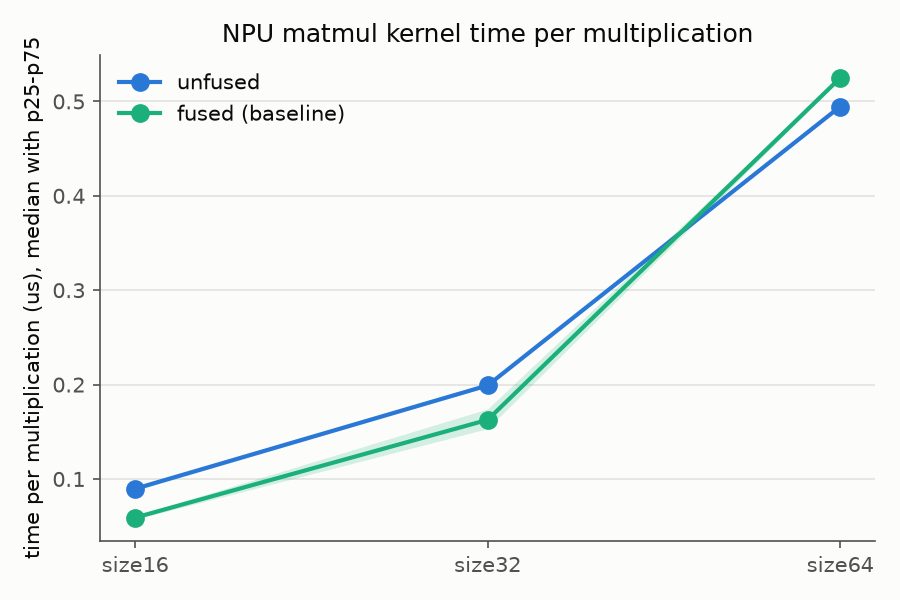
Measured time per multiplication (median, with the 25th–75th percentile band) for our approach (“unfused”) and the fused baseline, for \(M=N\in\{16,32,64\}\) and \(K=64\).
The two curves cross between \(N=32\) and \(N=64\): the fused baseline is faster at the two smaller sizes, while our pre-converting approach is faster at \(N=64\). This is the crossover expected from both the analytical model and the static cycle counts.
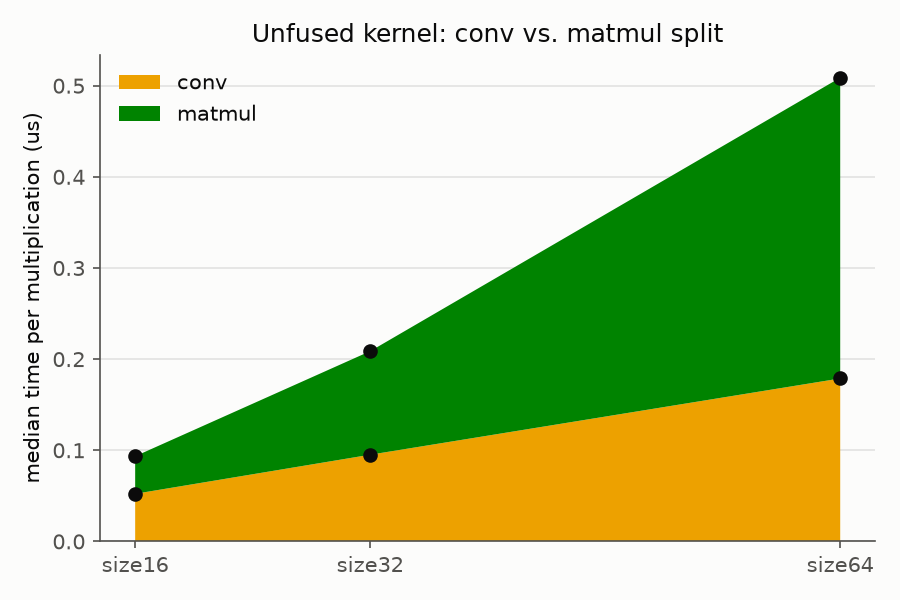
Time per multiplication of our approach, split into the conversion and the matmul kernel (stacked; the markers show the two measured points).
Splitting our approach into its two kernels shows why: the conversion time grows roughly linearly with \(N\) (\(0.05 \to 0.10 \to 0.18\,\mu s\)), whereas the matmul time grows roughly quadratically (\(0.04 \to 0.11 \to 0.33\,\mu s\)), matching the \(\Theta(N)\) conversion cost and the \(\Theta(N^2)\) number of vmac.f instructions. The conversion’s share of the total therefore shrinks as the matrices grow, so the one-time conversion is increasingly amortized by the cheaper multiplication, which is the effect our approach relies on.
Finally, we compare the speedup of our approach over the fused baseline (baseline time / our time) from three sources: the measured benchmark times, the static cycle counts (baseline / (conversion + matmul)), and the analytical model from the Expected speedup section, which for \(M=N\) reduces to \(1.5N/(N+24)\).
\(N\) |
measured |
cycle counts |
analytical |
|---|---|---|---|
16 |
0.66 |
0.68 |
0.60 |
32 |
0.82 |
0.90 |
0.86 |
64 |
1.06 |
1.15 |
1.09 |
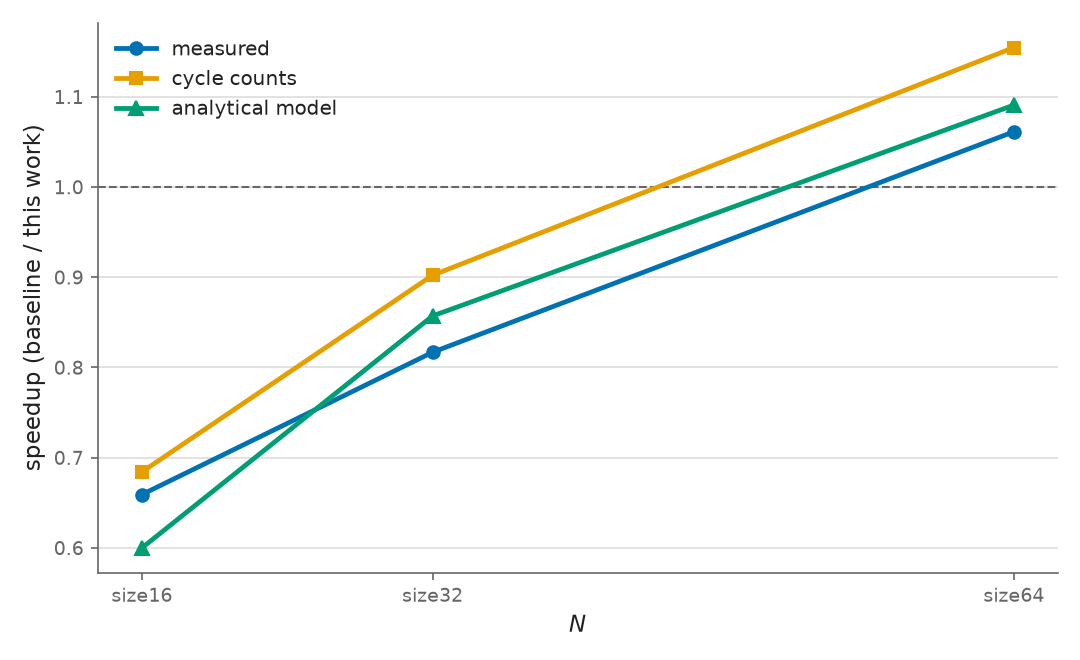
Speedup of our approach over the fused baseline (baseline time / our time) for \(M=N\in\{16,32,64\}\) and \(K=64\), from the measured times, the static cycle counts, and the analytical model \(1.5N/(N+24)\). A value above the dashed line at \(1\) means our approach is faster.
All three sources show the same trend and cross \(1\) between \(N=32\) and \(N=64\): our approach becomes faster only for the largest matrices, consistent with the analytical crossover at \(N=48\).
The analytical model deviates most at \(N=16\), where it predicts \(0.60\) while the measurement is \(0.66\). This is because the analytical model drops the constant \(\Theta(1)\) warmup and cooldown terms, whose relative weight is largest for the smallest kernel; the cycle-count curve, which includes these constants, stays closest to the measurement there (\(0.68\)). For \(N=32\) and \(N=64\) the measured speedup lies slightly below both predictions (\(1.06\) against \(1.15\) and \(1.09\) at \(N=64\)), consistent with the additional per-call host overhead that neither model captures. Overall, the expected trend is confirmed.